

How Honeybees in Winter Survive Ohio’s Cold: Inside the Winter Cluster
One of the biggest surprises for homeowners is learning that honeybees in winter are still very much alive. Wasps and bumblebees die off in fall, leaving only lone queens to start over in spring. A honeybee colony is different. The queen and thousands of workers stay together through the coldest Ohio months. As beekeepers, we spend our winters looking after our own colonies at Apiary #1 in Loudon Township, so here is a plain-language look at how they do it.
Honeybees in Winter Do Not Hibernate
Many insects go dormant in the cold. Honeybees do something different: they form a tight ball called a winter cluster and make their own heat. The University of Arkansas Cooperative Extension explains that honeybees begin to cluster whenever temperatures get down to about 55°F, gathering on the brood nest and around the queen (UA Cooperative Extension). Bees generate heat by vibrating their wing muscles, similar to the way our muscles shiver when we are cold, while resting bees on the outside form an insulating layer that keeps warmth trapped inside.
Inside the Winter Cluster
- The core stays warm. When brood (developing young) is present, the brood area is held at roughly 92 to 95°F, according to extension specialists at the University of Arkansas and the University of Florida (UF/IFAS IN1006).
- The outer shell insulates. Bees on the surface pack together and rest, holding heat in.
- Bees take turns. University of Arkansas extension describes bees in the center eventually making their way out to rest while others move in.
- The cluster moves with the food. UF/IFAS notes that the cluster gradually moves up through the colony as a unit, eating through stored honey as it goes.
Honey Is Winter Fuel
All that heat costs energy, and the fuel is honey. University of Arkansas extension explains that bees generate heat from the food they eat. Resting bees fill their honey crop from capped cells, a bit like topping off a fuel tank, and share that honey with other bees in the cluster. A colony that runs out of reachable honey during a long cold stretch can starve.
That is why beekeepers think about winter all year. In late summer and fall, the goal at the apiary is a strong colony with plenty of stored honey heading into the cold months.
Why You Might See Bees on a Warm Winter Day
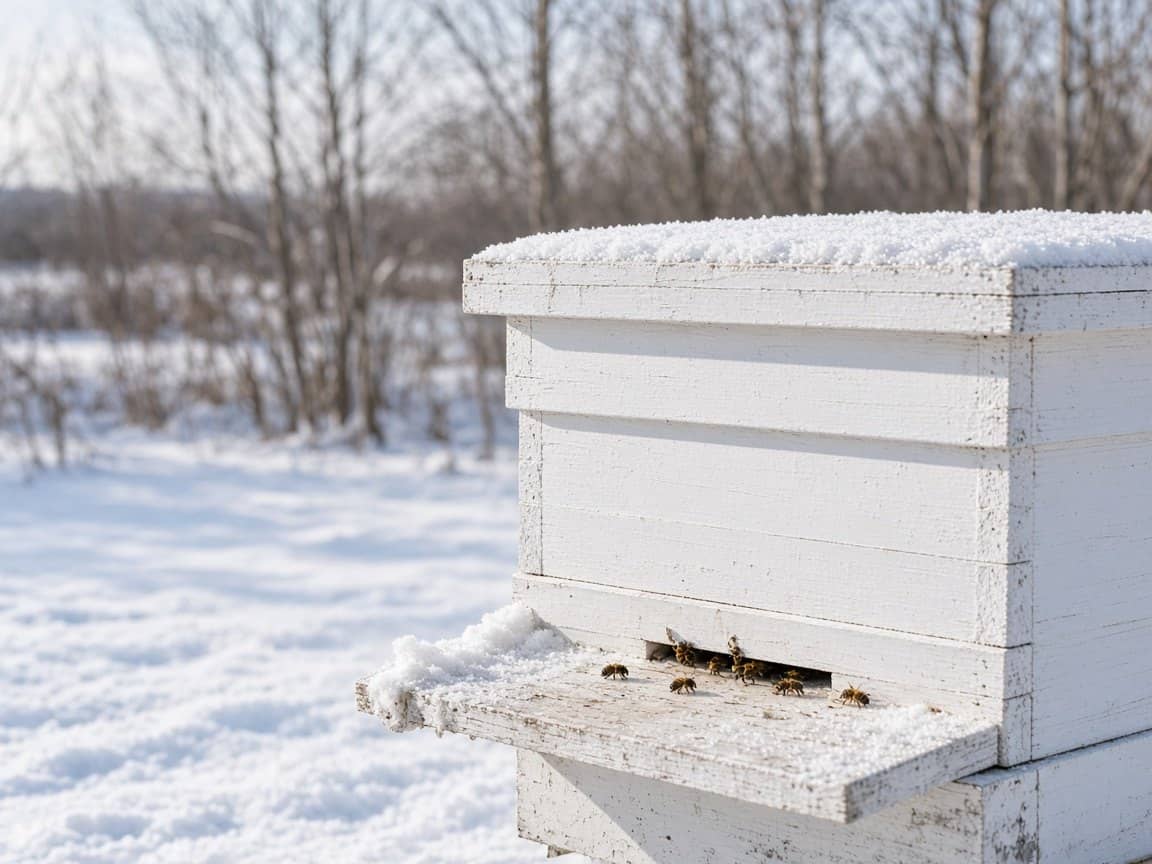
On sunny winter days, you may see bees flying near a hive or near a wall where a colony lives. University of Arkansas extension notes that warm days above about 55°F encourage bees to take cleansing flights and carry dead bees out of the hive. Seeing a few honeybees in winter is normal. It is a sign the colony is alive.
Is the Queen Still Laying?
Not much. University of Arkansas extension explains that in fall, as flowers become scarce, the queen slows down her egg production, so there is little to no brood as winter approaches and the colony can turn the heat down a little.
How Beekeepers Help Colonies Through Winter
Our job in winter is mostly to stay out of the way and make sure the bees have what they need. Extension specialists point to a few basics:
- Shelter without stuffiness. UF/IFAS notes that hives must be sheltered from the wind but still have enough air flow to keep moisture from building up inside, and that early-morning sun helps warm hives during the day.
- Top insulation with ventilation. In places that regularly freeze, UF/IFAS suggests a top-insulation system to slow heat loss as the cluster moves up, while keeping adequate ventilation.
- Emergency food. University of Arkansas extension describes candy boards, blocks of sugar candy placed on top of the hive, so the cluster can reach food wherever it is.
- Watch the weather. The same source notes that a winter with many warm days makes bees burn through their food faster.
What This Means for a Colony in Your Wall
If honeybees moved into your wall, soffit or chimney this year, they did not die when the weather turned. The colony is clustered on its comb inside the structure, living on the honey it stored. A few things follow from that:
- They will not leave on their own over the winter. A colony with comb and honey is settled in.
- Sealing the entrance is a bad idea. If the colony dies inside, the comb and honey left behind can cause new problems. See honeybees in your walls.
- Spraying is never the answer. Honeybees are always relocated by our team, never exterminated. Read why beekeepers never exterminate honeybees.
Relocations from structures are being scheduled for Spring 2027, so winter is a good time to get on the list. Our humane honeybee removal and relocation service is run by working beekeepers, and rescued colonies go to our sister company, The Mindful Beekeeper, where they pass through an inspection station before joining the apiary.
Frequently Asked Questions
Do honeybees sleep all winter?
No. Honeybees in winter stay active inside the cluster, generating heat and eating stored honey.
Do bees freeze or starve in winter?
University of Arkansas extension explains that bees make heat from the food they eat, so a colony that runs out of honey it can reach is in serious trouble. Plenty of stores within reach of the cluster is what gets a colony through.
Why is there a hum in my wall in January?
A living honeybee colony inside the wall makes that sound. Call us before you open anything up.
Honeybees Living in Your Home?
Call or text Northwest Ohio Wasp Removal at 419-614-6445 or visit our contact page. We are a beekeeper-owned, pesticide-free company serving Northwest Ohio, Eastern Indiana and Southern Michigan.