European Hornets in Ohio and Indiana: The Wasp That Flies at Night
If a huge, brown-and-yellow wasp has been bouncing off your porch light or tapping on a lit window after dark, you have probably met the European hornet. It is the largest wasp in Ohio and one of the most misunderstood. This guide covers how to identify European hornets, why they fly at night, where they nest, and when hornet removal makes sense for homeowners in Northwest Ohio, East Indiana, and Southern Michigan.
What Is the European Hornet?
The European hornet (Vespa crabro) is the only true hornet, genus Vespa, established in North America. It was introduced from Europe and first reported in the eastern United States in the 1800s. Today it is considered naturalized across much of the East, including Ohio, Indiana, and Michigan.
According to Ohio State University Extension, European hornets are beneficial predators that feed on caterpillars, grasshoppers, and other insects. Most of the time, they are more of a startle than a threat. Problems start when a colony nests in or near a home.
How to Identify a European Hornet
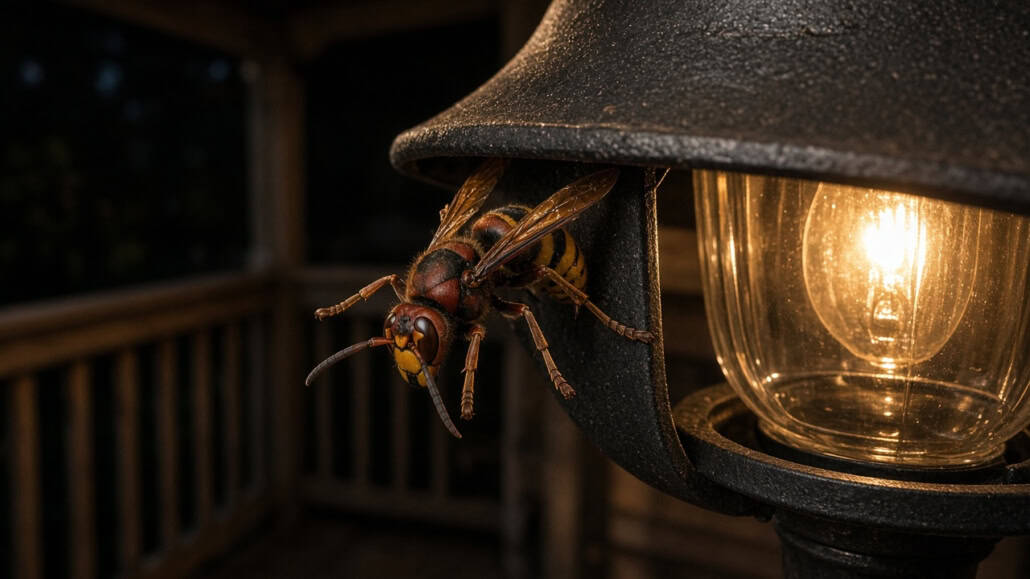
- Size: About 1 inch for workers, with queens reaching around 1.5 inches. Noticeably larger than a yellowjacket.
- Head and thorax: Reddish-brown or mahogany, with a yellow face.
- Abdomen: Yellow with dark bands that have teardrop-shaped extensions pointing toward the rear.
- Wings: Brownish or amber-tinted.
The European hornet is often mistaken for the northern giant hornet, the so-called “murder hornet.” That species has not been found in Ohio, Indiana, or Michigan. Read the current facts in our article on giant hornets in Ohio.
The Wasp That Flies at Night
What really sets the European hornet apart is that it is active after dark. Most wasps stay in the nest at night, but European hornets will forage and fly in the evening and overnight. That leads to a few common experiences:
- Hornets circling porch lights, garage lights, or flood lights
- Loud thumping against lit windows and screens at night
- Hornets flying toward headlights or flashlights near a nest
If you have a nest nearby, turning off exterior lights that shine toward it, or closing blinds on lit windows, can reduce night-time encounters.
Where European Hornets Nest

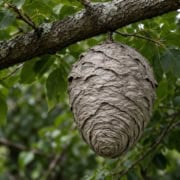
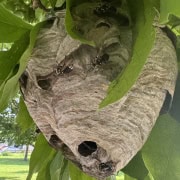
European hornets build light brown paper nests, usually inside a protected cavity rather than out in the open. In nature, that is typically a hollow tree. Around homes, Ohio State Extension notes they often choose:
- Attics and wall voids
- Barns, garages, and sheds
- Behind window shutters
- Gaps in rooflines and soffits
They tend to prefer entrances higher up, often six feet or more above ground. Colonies are annual. At their largest, a nest may contain a few hundred workers, and the old nest is not reused the next year.
Other Late-Summer Behaviors
- Bark stripping: European hornets peel bark from twigs of trees and shrubs, such as lilac and birch, to feed on sap. Damage is usually minor, though small branch tips can die if girdled.
- Sweet foods: In late summer, they are drawn to fallen fruit and sugary drinks.
- Hunting at hives: They will catch individual honeybees, though they are not known to wipe out apiaries the way some invasive Asian hornets can.
Are European Hornets Dangerous?
Away from the nest, European hornets are generally not aggressive. Near the nest, they will defend it, and their size makes for a painful sting. Because they fly at night, homeowners can also be surprised by them in the dark, which is one reason DIY treatment after dusk is risky.
Never block the entrance to a hornet nest in a wall. As Ohio State Extension warns, hornets can chew new exit holes through drywall and emerge inside the home. Our article on hidden nests in walls explains why sealing gaps too early backfires.
European Hornets vs. Other Large Wasps
Several big wasps in our region get mistaken for one another:
- European hornet: Reddish-brown head and thorax, yellow face, yellow abdomen with dark teardrop-marked bands, active day and night.
- Bald-faced hornet: Black and white, smaller, builds an exposed gray paper nest in trees or shrubs. See our guide to bald-faced hornets.
- Cicada killer: Similar size, but a black abdomen with pale yellow markings, and it nests in burrows in the ground, not in paper nests.
When to Call for Hornet Removal
A European hornet nest in a distant hollow tree can often be left alone. Consider professional hornet removal when:
- The nest is inside your attic, walls, garage, or barn.
- Hornets are entering your home or gathering at your doors and windows at night.
- The nest is near a deck, entry, or area your family uses daily.
- Someone in your household has a sting allergy.
Our pesticide-free approach physically removes the colony and nest, so nothing is left rotting inside your structure.
Preventing European Hornet Nests
- Inspect rooflines, soffits, shutters, and vents in early spring and seal openings before queens move in.
- Seal gaps around pipes and exhaust ducts.
- Pick up fallen fruit and keep trash cans closed.
- Use exterior lighting thoughtfully during late summer.
Frequently Asked Questions
Why are there hornets at my porch light at night?
European hornets are one of the few wasps that fly after dark and are attracted to lights. Frequent night visits suggest a nest somewhere nearby.
Is the European hornet the same as the murder hornet?
No. The northern giant hornet is a different species and has not been found in Ohio, Indiana, or Michigan. European hornets have lived in the eastern U.S. for well over a century.
Are European hornets protected?
They are a non-native species, but they are beneficial predators. We generally recommend leaving nests that are far from people and removing those inside or close to homes.
Where do you offer hornet removal?
We serve Northwest Ohio, East Indiana, and Southern Michigan.
Hornets Getting Too Close?
If European hornets are nesting in or near your home, visit our contact page to reach Northwest Ohio Wasp Removal.