Yellowjackets in Your Walls: Signs of a Hidden Wasp Nest and How It’s Removed
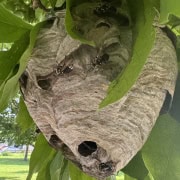
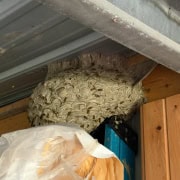
A few yellowjackets flying in and out of a gap in your siding may not look like much. But that small opening can lead to a nest the size of a basketball or larger inside your wall, attic, or ceiling. Hidden nests are some of the most common calls we get for wasp hive removal across Northwest Ohio, East Indiana, and Southern Michigan. Here is how to recognize the warning signs and what removal involves.
Why Yellowjackets Move Into Walls
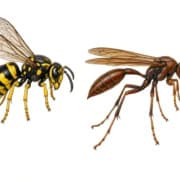
In spring, a single yellowjacket queen looks for a protected, dry cavity to start her colony. A wall void, attic space, or soffit is ideal: sheltered from rain, insulated, and hidden from predators. The German yellowjacket (Vespula germanica) is especially well known for nesting inside buildings, and the eastern yellowjacket will use structural voids as well.
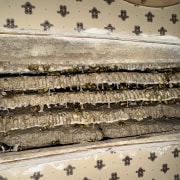
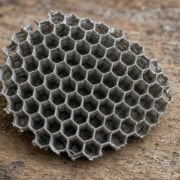
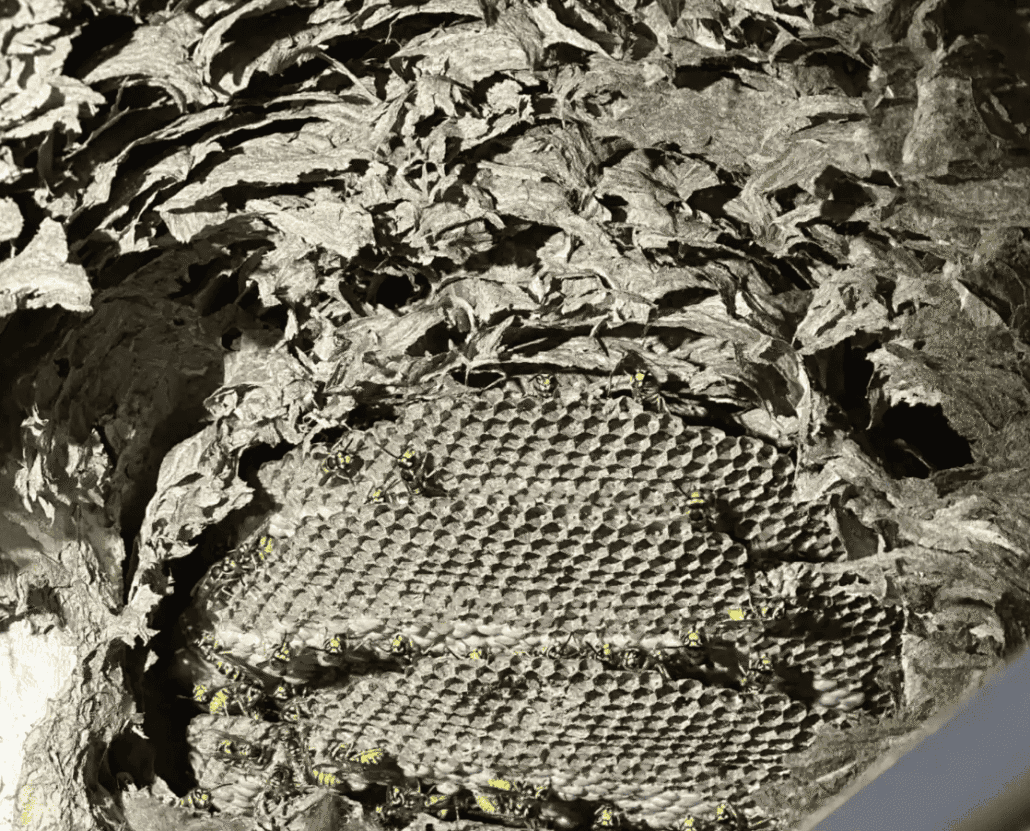
Over the summer, the colony grows from a handful of cells to stacked layers of paper comb. Workers chew away insulation and other soft materials to make room. By late summer, a wall nest can house thousands of yellowjackets.
Signs of a Hidden Wasp Nest in Your Walls

Steady traffic at a single gap
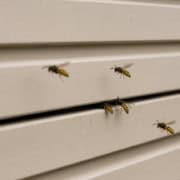
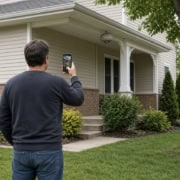
The most obvious sign is yellowjackets entering and leaving the same spot again and again: a crack in siding, a gap around a window or dryer vent, a weep hole in brick, a soffit seam, or a gable vent.
Scratching, crackling, or chewing sounds
Large colonies are surprisingly noisy. Some homeowners hear a faint rustling or crackling inside the wall, especially in a quiet room.
A warm, damp, or discolored spot on drywall
A big nest generates heat and moisture. In some cases, a stain or soft spot appears on interior drywall or a ceiling.
Yellowjackets inside the house
Finding yellowjackets indoors, particularly near light fixtures, outlets, or recessed lights, can mean the colony has chewed toward your living space. Treat this as urgent.
More activity in late summer
Wall nests often go unnoticed until August or September, when the colony is at its peak and traffic becomes impossible to miss.
Is It Yellowjackets or Honeybees?
Honeybees also move into walls, and the difference matters a great deal. Honeybees are fuzzy and golden-brown and often return carrying pollen. They can be active on warm days in early spring or even winter, while yellowjacket colonies die off each fall. If you see wax or honey, or notice a sweet smell, it is likely honeybees, and they are always relocated alive, never exterminated. Read more in our article on honeybees in your walls, or compare species in our identification guide.
Common Entry Points We See

Yellowjackets need surprisingly small openings to reach a wall void. Some of the most common entry points in Northwest Ohio homes include:
- Gaps where vinyl siding meets trim, corners, or the foundation
- Weep holes and mortar gaps in brick
- Loose or damaged soffit panels and fascia
- Gable, ridge, and attic vents with torn or missing screens
- Openings around dryer vents, exhaust fans, pipes, and utility lines
What Not to Do
- Do not seal the entrance. This is the most common mistake. Blocked yellowjackets will look for another way out, and that can be through your drywall into the house.
- Do not spray into the gap. Store-bought sprays rarely reach a nest deep inside a wall and can drive the colony further into the structure.
- Do not cut into the wall yourself. Opening a wall with an active colony behind it is extremely dangerous.
Our article on why DIY wasp spray often makes things worse explains these risks in more detail.
How Wasp Hive Removal From a Wall Works
We have removed yellowjacket nests from attics, foundations, basements, walls, ceilings, and other hard-to-reach spots. Every job is different, but the process generally looks like this:
- Confirm the insect and locate the nest. The entrance is not always directly over the nest, so pinpointing the nest itself is a key first step.
- Plan access. Depending on the structure, the nest is reached from the inside or outside with the least possible disturbance to your home.
- Remove the colony and the paper nest. Our methods are pesticide-free, so nothing is sprayed into your home.
- Leave nothing behind to rot. When a wall nest is simply sprayed and left, the dead colony and larvae decompose inside the wall, which can create odor and attract other pests. Removing the nest prevents that.
Why Removing the Nest Matters
A yellowjacket nest in a wall is made of paper, larvae, and adult wasps. When it is poisoned in place:
- Activity can continue for days or weeks while you wait.
- Surviving wasps may find a way into your living space.
- The dead nest can smell and attract beetles and other scavengers.
- The homeowner is often left to deal with the remains later.
Physically removing the nest solves the problem at the source.
Frequently Asked Questions
Can yellowjackets chew through drywall?
Yes. Yellowjackets chew soft materials as their nest expands, and they can break through drywall or ceiling material, especially when an entrance has been blocked.
Will the nest come back next year?
Yellowjackets do not reuse old nests, but a new queen may choose the same void if the entrance is still open. Sealing gaps after the nest is removed, ideally in late fall or winter, helps prevent a repeat.
How do I know if a wall nest is large?
Heavy, constant traffic, noise inside the wall, and late-summer timing all point to a large colony. The only way to know for sure is to locate the nest.
Where do you offer wasp hive removal?
We serve Northwest Ohio, East Indiana, and Southern Michigan.
Suspect a Nest Inside Your Walls?
Do not seal it and do not spray it. Visit our contact page to reach Northwest Ohio Wasp Removal, and we will help you figure out what is inside and how to get it out.