
Mud Daubers and Cicada Killers: Ohio’s Gentle Solitary Wasps
Not every wasp around your home is a threat. Some of the most alarming-looking insects in Ohio are actually solitary wasps that rarely sting people and help keep spiders and cicadas in check. Before you search for wasp removal, it is worth getting to know two of the most common: mud daubers and cicada killers. Here is how to recognize them, why they behave the way they do, and when, if ever, they need attention in Northwest Ohio, East Indiana, and Southern Michigan.
Social vs. Solitary Wasps
The wasps that cause most problems, like yellowjackets, bald-faced hornets, and European hornets, are social. They live in colonies with a queen and many workers that defend the nest together. That group defense is what makes them dangerous.
Solitary wasps are different. Each female builds and stocks her own nest. There is no colony and no army of workers to defend it. As a result, solitary wasps are generally far less likely to sting, and when they do, it is usually because they were handled or trapped against skin.
Not sure which kind you have? Start with our wasp, bee, and hornet identification guide.
Mud Daubers: Ohio’s Spider Hunters

What they look like
Mud daubers are slender wasps with an extremely long, thin, threadlike “waist.” The most common types in our area include:
- Black-and-yellow mud dauber (Sceliphron caementarium): black with yellow markings and yellow legs.
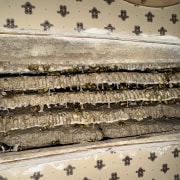
- Organ-pipe mud dauber (Trypoxylon politum): shiny black, builds long parallel mud tubes that resemble organ pipes.
- Blue mud dauber (Chalybion californicum): metallic blue-black, often reuses old nests built by other mud daubers.
Their nests
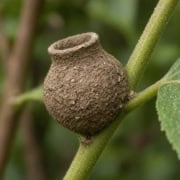
Instead of paper, mud daubers build with mud. Look for lumpy clusters of mud cells or tube-shaped nests on protected surfaces: under eaves, in garages, sheds, barns, porch ceilings, attics, and even on the underside of outdoor furniture.
What they do
Each female collects mud from puddles and stream banks, builds cells, and stocks them with paralyzed spiders for her larvae to eat. Blue mud daubers are known for hunting black widow spiders. In other words, mud daubers are free spider control.
Do mud daubers sting?
Rarely. They are not defensive and will usually fly away if approached. Stings typically only happen if one is grabbed or pressed against skin.
Cicada Killers: Big, Loud, and Mostly Harmless
What they look like
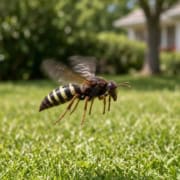
The eastern cicada killer (Sphecius speciosus) is one of the largest wasps in Ohio, around 1.5 inches long or more. It has a reddish-brown head and thorax, amber wings, and a black abdomen with pale yellow markings. Because of their size, cicada killers are often mistaken for “murder hornets.” Our article on giant hornets in Ohio covers that confusion.
When and where you will see them
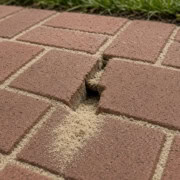
Cicada killers appear in mid to late summer, typically July and August, which lines up with the annual cicadas they hunt. Females dig burrows in well-drained, sandy, or bare soil: along sidewalks and driveways, in thin lawns, sandboxes, flower beds, and the edges of patios. You will often see a small fan of loose soil spilling out of each hole.
What they do
According to Ohio State University Extension, each female digs a tunnel, stings and paralyzes an annual cicada, drags it into an underground chamber, and lays an egg beside it. The larva feeds on the cicada, then overwinters in the burrow and emerges the next summer.
Do cicada killers sting?
Females can sting but are very unlikely to sting people unless handled or stepped on barefoot. Males cannot sting at all. The males are the ones you notice: they patrol the nesting area, hover in your face, and dive-bomb passersby. It is all bluster.
Do Mud Daubers or Cicada Killers Need Wasp Removal?
Usually, no. Both are beneficial and low-risk. That said, there are a few situations where action makes sense:
- Mud dauber nests in a bad spot: Old, empty mud nests can be scraped off with a putty knife. Check that they are inactive first.
- Cicada killer burrows in a high-traffic area: Heavy nesting in a sandbox, play area, or along a path can be a nuisance. Watering, thickening the lawn, and mulching bare soil make the area less attractive next year.
- You are not sure what you have: If insects are pouring out of a single hole in large numbers, that is more likely a yellowjacket ground nest, which is a different and more dangerous situation. See our guide to yellowjacket ground nests.
How to Tell Cicada Killer Burrows From Yellowjacket Nests
- Cicada killers: Many individual holes, each with a fan of loose soil, wasps coming and going one at a time, large wasps, and July to August timing.
- Yellowjackets: Usually one entrance, a steady stream of many small wasps flying in and out, and aggressive defense when disturbed, peaking in August and September.
Why We Do Not Recommend Spraying
Our company is owned by a beekeeper, and our methods are pesticide-free. Spraying lawns and eaves to kill solitary wasps also harms the pollinators and beneficial insects that share your yard. In most cases, a little patience and some habitat changes solve the problem.
Frequently Asked Questions
Are mud daubers dangerous to kids or pets?
Mud daubers are among the least aggressive wasps in Ohio. Stings are rare and usually only happen when one is grabbed.
Why is a giant wasp dive-bombing me in my yard?
That is most likely a male cicada killer guarding its territory. Males cannot sting.
Will cicada killers come back every year?
Often, yes. Larvae overwinter in the burrows and emerge the next summer. Changing bare, sandy soil into thick turf or mulch can reduce nesting.
Do you serve areas outside Ohio?
Yes. We serve Northwest Ohio, East Indiana, and Southern Michigan.
Not Sure If It Is Harmless?
If you are not sure whether you are dealing with a solitary wasp or a dangerous colony, we are happy to help identify it. Visit our contact page to reach Northwest Ohio Wasp Removal.