Blue-Winged Wasp Over Your Lawn? Meet the Gentle Grub Hunter
It’s August, and a dozen dark wasps are flying low, looping figure-eights a few inches above your lawn. They don’t seem interested in you, but there are a lot of them. Most of the time, these are blue-winged wasps, and they’re doing you a favor. A blue-winged wasp hunts the white grubs that feed on grass roots, and it rarely, if ever, stings people.
How to Recognize a Blue-Winged Wasp
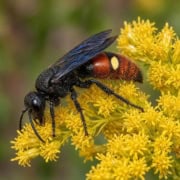
Ohio State University’s Buckeye Yard and Garden Line describes the blue-winged wasp (Scolia dubia) as having dark blue wings, legs and thorax, with its most distinguishing feature being two light-yellow spots on top of an orange-tipped abdomen (OSU BYGL). North Carolina State Extension adds that the adult is over 1/2 inch long, with the hind part of the abdomen reddish brown and somewhat fuzzy, and that the two yellow spots can look like a band when the wasp is flying (NC State Extension). University of Maryland Extension puts them at about 5/8 inch long (UMD Extension).
What They’re Doing Over Your Lawn
OSU explains that the wasps usually fly a few inches above the turf, often in loops or a figure-eight. They’re searching for white grubs, with a particular liking for green June beetle and Japanese beetle grubs. When a wasp locates a grub, it digs into the soil, stings and paralyzes the grub, and lays an egg on it. The wasp larva then feeds on the grub. OSU notes their impact on white grub populations can be significant.

NC State notes blue-winged wasps are present from June to October but most abundant in August, and are often noticed over lawns infested with white grubs. A lot of wasps over one patch of lawn can be a hint that there are a lot of grubs below. Maryland Extension adds that they fly over lawns during the day, leave in the early evening and disappear at the end of the season.
Do Blue-Winged Wasps Sting?
Maryland Extension says scoliid wasps are not aggressive and generally do not attack people. NC State says they rarely, if ever, sting people, and because they help control beetle grubs, no control measures are suggested. Maryland Extension agrees that control is not necessary or recommended.
Pollinators, Too
OSU notes the blue-winged wasp is also a pollinator. Adults sip nectar from flowers, most often common goldenrod, and OSU suggests that a good late-season nectar source like goldenrod can help draw these wasps in to reduce white grubs.
Blue-Winged Wasp or Something Else?
- Cicada killers are much larger and also dig in lawns. See mud daubers and cicada killers and our cicada killer relocation service.
- Yellowjackets fly in and out of one hole, not in loops across the whole lawn. See ground bees vs. yellowjackets.
- Other gentle diggers: see great black and golden digger wasps.
Frequently Asked Questions
Should I treat the lawn to get rid of them?
The wasps themselves don’t need control. If grubs are damaging your lawn, that’s a separate turf question.
Are they safe around kids and pets?
The extension sources above describe them as non-aggressive. Teach kids not to grab or step on any wasp. See kids and pets around wasps.
What other harmless wasps are there?
See potter wasps and ichneumon wasps.
Want a Second Opinion?
Text a photo or short video to Northwest Ohio Wasp Removal at 419-614-6445, or use our contact page. If it’s a nest that needs attention, our wasp and hornet nest removal uses no pesticides.