
Great Black Wasps and Golden Digger Wasps: Ohio’s Big but Gentle Wasps
In mid to late summer, gardeners across Northwest Ohio, Eastern Indiana and Southern Michigan often spot a big, glossy black wasp or a large orange-and-black wasp working the flowers. They look alarming, but great black wasps and great golden digger wasps are among the most gentle wasps you will ever meet. They are solitary hunters, they have no colony to defend, and they rarely sting people. Here is how to recognize them and why they usually do not need wasp removal at all.
Great Black Wasps (Sphex pensylvanicus)
How to Identify Great Black Wasps
- Size: Large, often more than an inch long. Females are bigger than males.
- Color: Entirely glossy black body.
- Wings: Dark, smoky wings that often shine blue or purple in sunlight.
- Shape: A long, thin waist between the thorax and abdomen.
What Great Black Wasps Do
Adults feed on nectar and are frequent visitors to flowers like mountain mint, milkweed, goldenrod and Queen Anne’s lace. Females hunt katydids and similar insects, sting them to paralyze them, and carry them to a burrow dug in the soil. They lay an egg on the prey, and the larva feeds on it. Each female works alone.
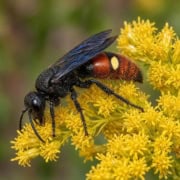
Great Golden Digger Wasps (Sphex ichneumoneus)
How to Identify Great Golden Digger Wasps
- Size: Large, roughly an inch long.
- Color: A black head, a thorax covered in short golden hair, and an abdomen that is orange-red at the front and black at the tip.
- Legs and wings: Orange-amber legs and amber-tinted wings.
- Shape: A slender wasp with a thin waist.
What Great Golden Digger Wasps Do
Like their all-black relatives, adults drink nectar from flowers. Females dig burrows in sandy or loose soil, often in lawns, garden edges, gravel paths or bare ground. They stock the burrows with paralyzed katydids, crickets and grasshoppers for their young. You may see several females digging in the same general area, but each has her own nest.

Are Great Black Wasps and Golden Digger Wasps Dangerous?
Very rarely. These are solitary wasps, so there is no nest full of workers ready to defend it. Females save their venom for paralyzing prey. Stings usually happen only if someone grabs one, steps on one barefoot or traps one against skin. Males cannot sting at all.
Compare that with social wasps like yellowjackets, bald-faced hornets and European hornets, which live in large colonies and defend their nests as a group. If you are not sure which kind you have, our guide to identifying wasps, bees and hornets in Ohio can help.
Why These Wasps Are Good to Have Around
- Natural pest control: They remove katydids, grasshoppers and crickets that feed on garden plants.
- Pollination: Adults visit many flowers for nectar and move pollen as they go.
- Low risk: They mind their own business and are not attracted to picnic food or trash.
Other Big Solitary Wasps in Our Area
Great black wasps and golden digger wasps are often confused with two other large solitary wasps:
- Eastern cicada killers: Very large wasps with black and pale yellow markings that dig burrows in sandy soil and hunt cicadas.
- Mud daubers: Slender wasps that build mud tubes or clumps on walls and under overhangs.
Learn more in our article on mud daubers and cicada killers. If you are seeing holes in your lawn and are not sure what made them, read ground bees vs. yellowjackets.
Do You Need Wasp Removal?
In almost every case, no. These wasps are active for a limited time in summer, and the adults die off by fall. Tips for living with them:
- Wear shoes in areas where they are digging.
- Let them forage on your flowers. They are not interested in you.
- If burrows are in a play area you want to discourage, water and overseed bare soil. These wasps prefer dry, loose ground.
Call us if you are not sure what you are dealing with, if wasps are going into a single busy hole in the ground or a wall, or if someone in your home has a sting allergy. Those can be signs of yellowjackets, which do call for professional wasp removal. See our guide to yellowjacket ground nests.
Frequently Asked Questions
Is a big black wasp the same as a murder hornet?
No. Great black wasps are native, solitary and gentle. Northern giant hornets have not been found in our region. See our article on giant hornets in Ohio.
Do great golden digger wasps live in colonies?
No. Several may nest near each other, but each female digs and provisions her own burrow.
Will they come into my house?
It is uncommon. They nest in soil and spend their time on flowers and hunting in vegetation.
Have a Big Wasp You Want Identified?
Call or text a photo to Northwest Ohio Wasp Removal at 419-614-6445 or visit our contact page. We serve Northwest Ohio, Eastern Indiana and Southern Michigan.