Bald-Faced Hornets in Ohio: Identifying the Big Gray Paper Nest
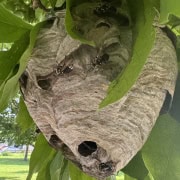
If you have spotted a large, gray, papery ball hanging from a tree, a shrub, or the eave of your house, you are probably looking at a bald-faced hornet nest. These nests are one of the most recognizable sights of late summer in Northwest Ohio, East Indiana, and Southern Michigan, and they are also one of the most common reasons homeowners search for hornet nest removal. Here is how to identify bald-faced hornets, understand how their nests grow, and decide when a nest needs to go.
What Is a Bald-Faced Hornet?
The bald-faced hornet (Dolichovespula maculata) is not actually a true hornet. It belongs to the aerial yellowjacket group. In Ohio, the only true hornet is the European hornet, which we cover in our guide to European hornets.

How to recognize a bald-faced hornet:
- Color: Black with white or ivory markings, especially on the face and the tip of the abdomen. That white face is where the name comes from.
- Size: Roughly 5/8 to 7/8 of an inch long, noticeably larger and heavier than a typical yellowjacket.
- Behavior: Workers hunt other insects, including flies and even yellowjackets, to feed their larvae.
For a broader comparison, see our wasp, bee, and hornet identification guide.
Identifying the Big Gray Paper Nest

Bald-faced hornet nests are distinctive once you know what to look for:
- Shape: Usually oval, teardrop, or “football” shaped, and they can grow larger than a basketball by late summer.
- Color and texture: Gray, papery, and layered, often with a swirled or scalloped pattern from the different wood fibers the workers chew.
- Entrance: A single opening, usually near the bottom of the nest.
- Inside: Several horizontal tiers of paper comb wrapped in the outer envelope.
- Location: Most often in trees and shrubs, sometimes under eaves, on sheds, or on other structures.
Nests are frequently hidden by leaves all summer and only become obvious in fall when the leaves drop. By then, many homeowners are surprised to realize how close they have been walking to an active colony.
How a Bald-Faced Hornet Colony Grows
Like other social wasps in our region, bald-faced hornets live in an annual colony:
- Spring: A queen that survived the winter in a sheltered spot starts a small nest about the size of a golf ball and raises her first workers alone.
- Early summer: Workers take over building and foraging. The nest grows steadily.
- Late summer: The colony reaches its peak, often a few hundred workers. Extension sources commonly cite around 100 to 400 workers, with some colonies larger.
- Fall: New queens and males are produced. The colony declines and dies with cold weather. Only mated queens overwinter, and the old nest is never reused.
Our month-by-month wasp season guide shows how this cycle lines up with other stinging insects.
Are Bald-Faced Hornets Dangerous?
Bald-faced hornets are not aggressive when they are away from the nest, but they defend it vigorously. Disturbing a nest by bumping a branch, trimming a hedge, mowing close to a low shrub, or throwing something at it can bring out many defenders at once. They can sting repeatedly, and their stings are painful.
The risk depends almost entirely on location:
- High in a tree, far from activity: Often low risk, and the colony will die off naturally after hard frosts.
- In a shrub by a door, walkway, deck, or play area: High risk, especially for children and anyone with a sting allergy.
- On the house, a shed, or a garage: High risk because of frequent nearby activity.
- In a hedge that needs trimming: High risk. Many serious multiple-sting incidents happen with hedge trimmers.
When You Need Hornet Nest Removal
Consider professional hornet nest removal if:
- The nest is within reach of people, pets, doors, or walkways.
- The nest is in a shrub or hedge you need to maintain.
- Anyone in the household has a known sting allergy.
- The nest is large and the colony is very active.
- You or a family member has already been stung near the nest.
Please do not knock the nest down, shoot it, spray it from a ladder, or try to bag it. These approaches put you right in the middle of an angry colony. Our article on why DIY knockdowns backfire explains why.
Bald-Faced Hornets Are Also Beneficial
It is worth remembering that bald-faced hornets are predators of flies, caterpillars, and other insects. A nest high in a tree at the back of a property is doing a lot of natural pest control. We generally recommend removal when the nest creates a real risk for people, not simply because it exists.
How We Remove Bald-Faced Hornet Nests
Northwest Ohio Wasp Removal uses pesticide-free methods. The colony and the paper nest are physically removed rather than sprayed and left hanging. That means no poisons around your trees, garden, or home, and no waiting days for activity to stop.
Frequently Asked Questions
Is a bald-faced hornet a hornet or a yellowjacket?
It is an aerial yellowjacket. The name “hornet” is a common nickname, but the only true hornet in Ohio is the European hornet.
Will bald-faced hornets come back to the same nest next year?
No. The nest is used for a single season. A new queen may build in the same general area, but the old nest will not be reoccupied.
Should I remove an empty nest in winter?
Once a nest is abandoned after hard frosts, it is generally safe to take down. Some people keep them as curiosities. Just be certain the colony is no longer active.
Do you provide hornet nest removal outside Ohio?
Yes. We serve Northwest Ohio, East Indiana, and Southern Michigan.
Have a Hornet Nest Near Your Home?
If a bald-faced hornet nest is too close for comfort, we can help. Visit our contact page to reach Northwest Ohio Wasp Removal.