
Aerial Yellowjackets: How to Spot an Aerial Yellowjacket Nest in Trees and Shrubs
Most people picture yellowjackets nesting in the ground or inside a wall. But one group of yellowjackets builds its nests out in the open, hanging in trees, shrubs and hedges or tucked under eaves. If you have found a gray paper ball in your bushes, you may be dealing with an aerial yellowjacket nest. Here is how to recognize these wasps, why their nests are easy to bump into, and when to call for wasp nest removal in Northwest Ohio, Eastern Indiana or Southern Michigan.
What Are Aerial Yellowjackets?
“Aerial yellowjackets” usually refers to wasps in the genus Dolichovespula. Unlike ground-nesting yellowjackets in the genus Vespula, they build their nests above ground. Two species are common in our region:
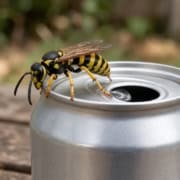
- The aerial yellowjacket (Dolichovespula arenaria): A black-and-yellow wasp that looks a lot like a typical yellowjacket.
- The bald-faced hornet (Dolichovespula maculata): Black and white instead of black and yellow. Despite the name, it is not a true hornet. It is an aerial yellowjacket. Our article on bald-faced hornets covers them in detail.
How to Identify an Aerial Yellowjacket Nest
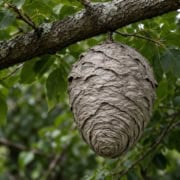
An aerial yellowjacket nest is a round to teardrop-shaped ball made of gray or tan paper. Like other social wasps, the builders make paper by chewing wood fiber and mixing it with saliva. Key features:
- A paper envelope: Layers of wavy, scalloped paper wrap around the combs inside, so you cannot see the cells.
- One entrance: Usually a single hole near the bottom.
- Size: Aerial yellowjacket nests are often softball to football sized. Bald-faced hornet nests can grow larger.
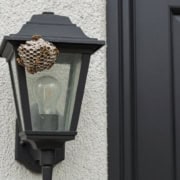
- Location: Shrubs, hedges, low tree branches, porch ceilings, eaves, sheds and sometimes inside attics or wall voids.
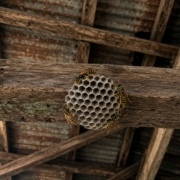
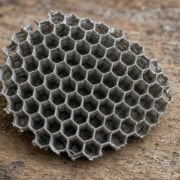
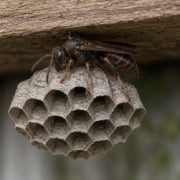
That is very different from a paper wasp nest, which is an open, umbrella-shaped comb with the cells exposed. For a side-by-side look at nest types, see how to identify a wasp nest by its shape.

Why Aerial Yellowjacket Nests Cause Problems
Aerial nests are easy to miss. They are often built inside dense shrubs or high in a tree, hidden by leaves. Homeowners usually find them by accident:
- Trimming hedges or shrubs with power trimmers
- Mowing close to a low bush
- Kids playing in or around landscaping
- Pruning fruit trees or picking fruit
The vibration of trimmers or mowers can set off the colony. Aerial yellowjackets defend their nest strongly, and they can sting repeatedly. Unlike ground-nesting yellowjackets, they are not big scavengers at picnics. They mostly hunt live insects to feed their young, which is why most people never notice them until the nest is disturbed.
The Aerial Yellowjacket Life Cycle
Like other yellowjackets in our region, an aerial yellowjacket colony lives for one season:
- Spring: A mated queen comes out of hibernation and builds a small starter nest alone.
- Early summer: Workers take over building and foraging, and the nest grows quickly.
- Mid to late summer: The colony produces new queens and males. Aerial yellowjacket colonies often peak and decline earlier in the season than ground-nesting yellowjackets.
- Fall: The colony dies. Only new queens survive, hibernating in sheltered places. The old nest is not reused.
Spotting a starter nest in late spring is the easiest time to deal with it. Our article on spring wasp queens explains why. For a month-by-month view, see our wasp season guide.
Where We Find Aerial Nests Around Homes
- Boxwoods, yews, arborvitae and other dense evergreen shrubs
- Ornamental and fruit trees, often at head height
- Under eaves, porch ceilings and deck railings
- Inside sheds, barns and garages with open doors
- Occasionally in attics or wall voids, entering through a gap
When You Need Wasp Nest Removal
An aerial yellowjacket nest high in a tree far from the house may be left alone until frost ends the colony. Call for wasp nest removal when the nest is:
- In shrubs or hedges you need to trim
- Near doors, walkways, decks or play areas
- Close to where you mow or garden
- Anywhere near someone with a sting allergy
Our pesticide-free approach removes the colony and the nest without spraying poison into your landscaping. Please do not knock the nest down, hit it with a hose, or spray it yourself. That usually triggers a mass defense. Our article on DIY wasp nest removal mistakes explains why.
Frequently Asked Questions
Are aerial yellowjackets the same as bald-faced hornets?
Bald-faced hornets are one kind of aerial yellowjacket. The other common one in our area, Dolichovespula arenaria, is black and yellow.
Are aerial yellowjackets aggressive?
Away from the nest they mostly ignore people. Near the nest, especially if it is shaken, they defend it quickly and in numbers.
Will they rebuild in the same bush next year?
They do not reuse old nests, but a new queen may choose a similar sheltered spot nearby.
Found a Paper Nest in Your Shrubs or Trees?
Call or text Northwest Ohio Wasp Removal at 419-614-6445 or visit our contact page. We serve Northwest Ohio, Eastern Indiana and Southern Michigan.