
Yellowjacket vs. Paper Wasp: How to Tell Them Apart in 5 Seconds
Black and yellow, buzzing around the deck, and capable of a nasty sting. It’s easy to call everything a “yellowjacket.” But yellowjacket vs paper wasp is one of the most useful distinctions a homeowner can make, because the two behave differently, nest differently, and get handled differently. Here’s the five-second version, then the details.
The Five-Second Check
- Shape: Stocky and compact with a barely visible waist? Yellowjacket. Slender with long legs and a distinct, narrow waist? Paper wasp.
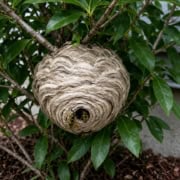
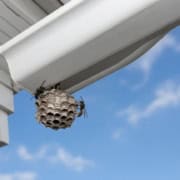
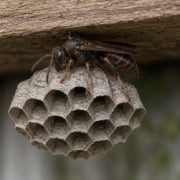
- Nest: Hidden in the ground or a wall, or inside a gray paper ball? Yellowjacket. Open, umbrella-shaped comb with visible cells? Paper wasp.
- At your food: Hovering over the burgers and soda? Almost certainly a yellowjacket.
Body Shape and Color
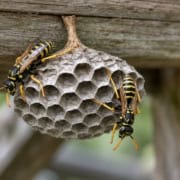
The University of California IPM program describes yellowjackets as 1/2 to 1 inch long with jagged bright yellow and black stripes and narrow waists that are barely visible (UC IPM). Paper wasps, by contrast, have long legs and a distinct slender waist. Clemson Extension notes that common paper wasps are about 5/8 to 3/4 inch long and many are brownish with yellow markings, though some have reddish markings (Clemson HGIC: Paper Wasps).
Nests: Yellowjacket vs Paper Wasp
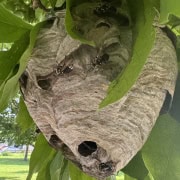
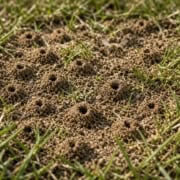
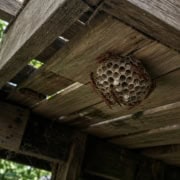
This is often the easiest clue. UC IPM explains that yellowjackets nest in holes in the ground, inside wall cavities, or in hanging nests totally enclosed in gray paper with a single entrance. Paper wasps build paper nests with many open cells, often under eaves. Each one hangs like an open umbrella, and UC IPM notes they rarely exceed the size of an outstretched hand.

Our guide to identifying a wasp nest by shape has more examples, and yellowjacket ground nests covers the ones in your lawn.
Behavior
UC IPM says paper wasps are much less defensive and rarely sting people, tending to shy away from human activity unless their nest is near a door, window or other high-traffic spot. Yellowjackets are the ones that scavenge on human food. Ohio State University Extension notes their food preferences shift from proteins to sweets in late summer, which is when they become persistent guests at picnics (OSU Extension HYG-2075). See why wasps get aggressive in late summer.
Why It Matters for Removal
The species decides the plan. We relocate native paper wasps. European paper wasps, yellowjackets and hornets are removed. Either way, it’s done by hand or vacuum, with no pesticides. Our post on native vs. European paper wasps explains how to tell those two apart.
Frequently Asked Questions
What about hornets?
Bald-faced hornets are close relatives of yellowjackets. See bald-faced hornet vs. yellowjacket.
Could it be a bee?
Fuzzy and golden-brown usually means a honeybee. See honeybee vs. yellowjacket.
Is there a broader ID guide?
Yes. Start with how to identify wasps, bees and hornets in Ohio.
Not Sure Which You Have?
Text a photo to Northwest Ohio Wasp Removal at 419-614-6445, or reach us through our contact page. We’ll tell you what it is and give you a free virtual quote for our wasp and hornet nest removal.