
Bald-Faced Hornet vs. Yellowjacket: Same Family, Very Different Nests
Here’s a surprise for many homeowners: the bald-faced hornet isn’t a true hornet. It’s an aerial yellowjacket. So bald faced hornet vs yellowjacket is really a comparison between close cousins. They share a family and a life cycle, but their looks, nests and habits are different enough that telling them apart helps you describe what you’re seeing and stay out of trouble.
Same Family, Different Look
The University of California IPM program groups yellowjackets into two genera, Vespula and Dolichovespula, and notes that the aerial-nesting D. maculata, the bald-faced hornet, has white rather than yellow bands (UC IPM).
- Bald-faced hornet: North Dakota State University Extension describes it as about 3/4 to 1 inch long, black with light yellow to white markings and a white tip at the end of the abdomen (NDSU Extension).
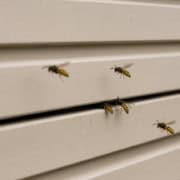
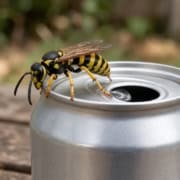
- Yellowjacket: Ohio State University Extension says a typical worker is about 1/2 inch long with alternating black and yellow bands (OSU Extension HYG-2075). UC IPM describes the stripes as jagged and bright.
Nests: The Biggest Difference
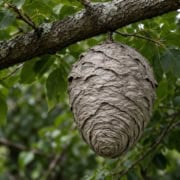
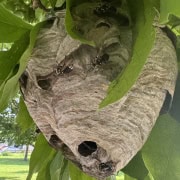
Bald-faced hornets build above ground. UC IPM explains that aerial nesters attach their paper nests to the eaves of a building or hang them from tree limbs, with the entrance normally a hole at the bottom. OSU’s Buckeye Yard and Garden Line notes these hornets most commonly harvest gray, weathered wood, which produces gray nests (OSU BYGL), and that young nests are often tucked beneath protective foliage.
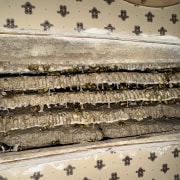
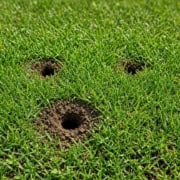
Yellowjackets usually hide their nests. The same BYGL article notes yellowjacket nests are structurally similar to bald-faced hornet nests, but they’re hidden below ground or in attics, behind walls or in other voids. All you usually see is an entrance hole with steady traffic.

See identifying a wasp nest by shape and aerial yellowjacket nests in trees and shrubs for more.
Behavior: Bald Faced Hornet vs Yellowjacket
UC IPM notes that aerial nesters like the bald-faced hornet don’t become scavengers at the end of the season, but they are extremely defensive when their nests are disturbed. Ground- and cavity-nesting yellowjackets are the ones that show up at picnics and garbage cans in late summer and fall. Both can sting repeatedly.
Another OSU BYGL article adds a useful perspective: paper wasps, yellowjackets and bald-faced hornets are seldom aggressive away from their nests (OSU BYGL). The risk is bumping into a nest you didn’t know was there, such as a hornet nest in a shrub or a yellowjacket nest under the lawn.
How We Handle Each
Both bald-faced hornet and yellowjacket nests are removed, by hand or vacuum, with no pesticides. Our pages on bald-faced hornet nest removal and yellowjacket ground nests go into detail.
Frequently Asked Questions
What’s a true hornet, then?
In our area, the European hornet. See European hornets in Ohio and Indiana.
Which German or Eastern yellowjacket is in my yard?
See Eastern vs. German yellowjackets.
How do paper wasps compare?
See yellowjacket vs. paper wasp.
Send Us a Photo
Call or text Northwest Ohio Wasp Removal at 419-614-6445 with a photo taken from a safe distance, or use our contact page. More about our wasp and hornet nest removal.
Sources
- University of California IPM: Yellowjackets and Other Social Wasps
- OSU Buckeye Yard and Garden Line: Winged Wolves with a Sweet Tooth
- OSU Buckeye Yard and Garden Line: It’s the Season for Yellowjackets, Paper Wasps, and Baldfaced Hornets
- Ohio State University Extension HYG-2075: Yellowjackets
- NDSU Extension: Insects That Look Like Bees