Yellowjackets in Ohio: Why Ground Nests Are So Dangerous
Most people picture a wasp nest hanging from a tree. In Ohio, some of the most dangerous nests are the ones you cannot see at all. Yellowjackets often build underground, and those hidden colonies are behind a large share of the painful multiple-sting incidents every summer. This guide explains why ground nests are so risky, how to spot one, and why yellowjacket nest removal is a job best left to a professional. We handle ground nests across Northwest Ohio, East Indiana, and Southern Michigan.
Meet the Ground-Nesting Yellowjacket
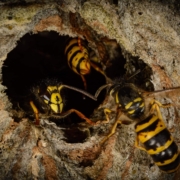
The eastern yellowjacket (Vespula maculifrons) is one of the most common stinging insects in our region, and it usually nests below ground. Queens often take over an abandoned rodent burrow or a natural cavity among roots or under landscape timbers, then build a paper nest inside and enlarge the space as the colony grows.
Yellowjackets are about half an inch long, bright yellow and black, and smooth rather than fuzzy. They fly fast and low, which makes their entrance easy to miss until you are standing right on top of it. Not sure whether you are seeing yellowjackets or bees? Our stinging insect identification guide can help.
Why Ground Nests Are So Dangerous
You cannot see them coming
A ground nest entrance is often just a small hole in the lawn, a gap along a sidewalk, or an opening under a step. There is usually no visible paper nest above ground. Many people find a nest the hard way: by stepping on it, mowing over it, or pulling weeds next to it.
Vibration sets them off
Lawn mowers, string trimmers, children running, and even a dog digging send vibrations straight into the nest. Yellowjackets respond by pouring out of the entrance to defend the colony.
They attack in numbers
When a yellowjacket stings or is crushed, it releases an alarm pheromone that signals other workers to join the defense. By late summer, a single colony can have thousands of workers, so a disturbance can quickly turn into dozens of stings.
They can sting repeatedly
Unlike a honeybee, a yellowjacket’s stinger is not barbed, so a single wasp can sting more than once. That is part of why yellowjacket encounters are so much worse than a typical bee sting.
Late summer is the peak
Colonies start in spring with one queen and grow all season. In August and September, nests are at their largest and workers are at their most defensive, which is also when people are mowing, gardening, and spending the most time outside. Our wasp season guide walks through the full yearly cycle.
How to Spot a Yellowjacket Ground Nest

- A steady stream of traffic: Yellowjackets flying in and out of the same small hole, often in a straight line.
- Common locations: Lawns, flower beds, along foundations, under decks and steps, beneath landscape timbers or old boards, and around tree roots.
- Bare soil near the entrance: Sometimes you will notice a little loose soil, but often there is nothing obvious.
- Unusual activity around one spot: If your dog keeps getting stung in the same corner of the yard, there is likely a nest nearby.
The safest way to confirm a nest is to watch from a distance, ideally from the side and not in the flight path, during the warm part of the day when traffic is highest.
What Not to Do
- Do not pour gasoline or other chemicals into the hole. It is a fire and contamination hazard, and it often fails to reach the whole nest.
- Do not plug or cover the entrance. Yellowjackets will simply dig a new exit, sometimes toward your foundation or into a crawlspace.
- Do not flood it with a hose. This rarely works and usually just stirs up the colony.
- Do not mow or trim nearby until the nest is handled.
- Do not rely on store-bought spray. It rarely reaches a nest that sits well below the surface.
How Professional Yellowjacket Nest Removal Works
Our approach is pesticide-free. Rather than spraying poison into the ground and hoping it reaches the nest, the colony and the paper nest are physically removed. Here is the general process:
- Confirm the species and locate the entrance and the likely size of the nest.
- Plan the removal around the colony’s defensive behavior, keeping people and pets well away.
- Remove the colony and the nest from the ground.
- Check for other nests. Yards that have one ground nest sometimes have another.
Because the nest is removed rather than left to die in place, activity ends without waiting days for a chemical to work, and there are no pesticides left in your lawn or garden.
Preventing Ground Nests Next Year
- Fill old rodent burrows and holes in the lawn in early spring.
- Remove old boards, unused landscape timbers, and debris lying on soil.
- Keep trash cans tightly closed and clean up fallen fruit and outdoor food.
- Walk your yard in late spring and early summer, when nests are still small and easy to spot.
Frequently Asked Questions
Are ground wasps the same as yellowjackets?
Most “ground wasp” nests in Ohio that send out swarms of defenders are yellowjackets. Some solitary wasps, like cicada killers, also dig burrows but rarely sting people. Learn more in our article on mud daubers and cicada killers.
Will a yellowjacket ground nest go away on its own?
The colony dies off after hard frosts, and only new queens survive the winter elsewhere. But leaving an active nest in a lawn or play area all summer is a real risk, especially in August and September.
Can bumblebees nest in the ground too?
Yes. Bumblebees often use old rodent burrows. They are far more gentle than yellowjackets, and we always relocate them. See our guide to bumblebee nests.
Do you remove ground nests outside Ohio?
Yes. We serve Northwest Ohio, East Indiana, and Southern Michigan.
Found a Ground Nest?
Keep everyone away from the area and let us handle it. Visit our contact page to reach Northwest Ohio Wasp Removal about yellowjacket nest removal.