
Wasp Nest in Siding: Why It’s Tricky and How It Comes Out
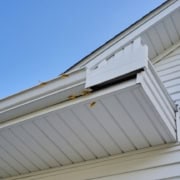
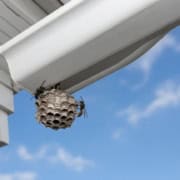
You notice wasps landing on the side of the house and disappearing into a seam in the siding. There’s no nest in sight, but the traffic doesn’t stop. A wasp nest in siding is one of the most common calls we get, and one of the most commonly mishandled. Here’s what’s going on, why the usual fixes backfire, and how it actually gets solved.
What’s Really Behind the Siding
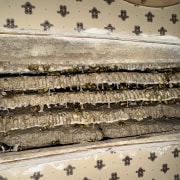
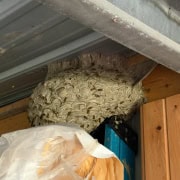
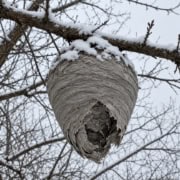
The nest isn’t on the siding. It’s behind it, in the wall space, the sheathing gap or the rim joist area. Ohio State University Extension notes that the German yellowjacket, now the dominant yellowjacket in Ohio, frequently builds nests in the walls of structures (OSU Extension HYG-2075). Yellowjacket nests are completely enclosed paper with many tiers of comb, and OSU reports they can reach roughly 4,000 to 5,000 workers by late summer.
The University of California IPM program adds that when a cavity isn’t big enough, yellowjackets enlarge it by moistening and digging, and inside a house this sometimes creates a wet patch that turns into a hole in a wall or ceiling (UC IPM).

Why a Wasp Nest in Siding Is Tricky
- You can’t see the nest. The entrance and the nest are often a foot or more apart, so spraying the gap rarely reaches the colony.
- Plugging the hole sends them indoors. OSU Extension warns not to plug the entrance of a wall nest, because disturbed wasps may enter the house. Clemson Extension likewise notes that wasps in buildings may find another exit and come inside (Clemson HGIC).
- Spraying stirs them up. A shot of spray into the seam angers the colony without ending it. See common DIY wasp spray mistakes.
- Ladders and angry wasps don’t mix. Many siding nests are at second-story height.
How It Comes Out
We start with a photo. Text us a shot of the gap and one wider picture of the wall, and we’ll give you a free virtual quote. On site, we locate the nest itself, not just the entrance, and remove the colony by hand or vacuum, with no pesticides. Taking the nest out, rather than just killing the wasps at the door, means the comb doesn’t stay behind in the wall.
Our post on yellowjackets in walls goes deeper on wall voids, and wasps in your attic or soffit covers nests higher up.
After the Nest Is Out
Once the colony is gone, the gap should be sealed so a new queen doesn’t move in next spring. See what to expect after wasp nest removal and our guide to wasp-proofing your home.
Frequently Asked Questions
Could it be honeybees instead?
Yes. Fuzzy, golden-brown insects in a wall may be honeybees, which we always relocate. Compare them with honeybee vs. yellowjacket, and see honeybees in walls.
Can I just wait for winter?
OSU notes the workers die with cold weather. If the entrance is far from doors and windows, waiting can be reasonable. If you’re seeing wasps indoors or near a doorway, don’t wait.
Should I caulk the seam now?
No. Sealing an active entrance is the same as plugging it. Seal only after the nest is out.
Get It Handled
Call or text Northwest Ohio Wasp Removal at 419-614-6445 with a photo, or visit our contact page. Learn more about our wasp and hornet nest removal. Please don’t spray or plug the gap before we arrive.